The SEC Just Made Public Fundraising Real for Filmmakers — Here’s What Actually Changed
If you’ve ever wanted to talk about your raise on Instagram, a podcast, or a festival panel — and stopped yourself because you weren’t sure it was legal — this is the update you’ve been waiting for.
On March 12, 2025, the SEC’s Division of Corporation Finance issued a no-action letter (requested by Latham & Watkins) and added two new Compliance and Disclosure Interpretations — Questions 256.35 and 256.36 — that fundamentally change how issuers can satisfy Rule 506(c)’s investor verification requirement. This is the biggest practical unlock for film financing under 506(c) since the rule launched in 2013.
Quick Refresher: Why 506(c) Matters to You
Rule 506(c) is the only version of Reg D that lets you publicly solicit — IG Lives, reels, podcasts, your newsletter, festival panels — as long as every investor who actually buys in is accredited and verified, not just self-certified.
Rule 506(b), by contrast, forbids general solicitation entirely. You can only raise from people you already have a substantive, pre-existing relationship with. That’s the rule most filmmakers default to without realizing it — and it’s why a cold outreach DM to a stranger who saw your trailer can get you into trouble.
The Old Hurdle
Under the prior standard, “reasonable steps” to verify accredited status meant collecting tax returns, W-2s, bank or brokerage statements, or a letter from a CPA, attorney, broker-dealer, or registered investment adviser — for every single investor, regardless of check size.
Try asking a potential $25K–$50K investor for their tax returns after they found you through an Instagram reel. Most filmmakers just avoided 506(c) altogether and stayed in 506(b), which meant no real public marketing was allowed at all.
What Changed
The SEC’s new guidance says an issuer can satisfy the “reasonable steps” verification requirement with no additional documentation if all of the following are true:
- A high minimum investment: $200,000 for individuals, $1 million for entities. Binding capital commitments made over time count — it doesn’t have to be all cash on day one.
- A written representation from the investor stating they are accredited, and that the investment is not being financed by a third party specifically to help them hit the minimum.
- No actual knowledge on your part that contradicts either of those representations.
Meet those three conditions, and the minimum investment amount itself functions as the verification — no tax returns, no bank statements, no third-party letters required.
This also extends to look-through entities: if an entity only qualifies as accredited because all of its owners are accredited, the entity needs to invest $1M, or $200K multiplied by the number of owners if there are fewer than five natural persons involved.
What This Means for Indie Film
Public pitching is finally usable. You can build a real content-to-deck-to-call funnel — the kind you can’t legally run under 506(b) — without needing a pre-existing relationship with every prospect.
It pushes you toward larger checks. This guidance doesn’t help you if your minimum is $10K. For most indie financing, that means restructuring around $200K minimums, using tranches, or aggregating smaller investors into an LLC where the LLC itself meets the $1M threshold (you still have to verify accreditation at the underlying owner level if you go this route).
What Didn’t Change
This is not a backdoor into crowdfunding from non-accredited investors — that’s still Regulation CF or Regulation A territory, an entirely different set of rules.
Every investor still has to be accredited at the time of sale. You still need a proper PPM, a subscription agreement, a Form D filing, state blue sky notices, bad actor checks, and offering materials free of return guarantees or misleading projections. The SEC continues to bring fraud cases against film offerings that skip verification, promise guaranteed returns, or misrepresent the production — so this relief is about verification paperwork, not a green light to loosen your marketing claims.
If You’re Structuring Around This
- File under 506(c) from day one if you intend to market publicly — check the 506(c) box on your Form D.
- Put the $200K individual / $1M entity minimum and the accredited-investor representation directly into your subscription documents. The representation language needs to track the no-action letter closely.
- Keep public materials to facts and your business plan — not “invest $10K, get 10x.” The verification relief is not a marketing relief; anti-fraud rules still apply in full.
- Document your process. Keep the signed written representation and a record that you had no contradictory information on file — for at least as long as your offering is open and for years after.
This is genuinely useful guidance, but it’s also easy to get the representation language wrong. This is not legal advice — if you’re restructuring an offering around this, run your subscription documents past a securities attorney who specifically handles entertainment 506(c) work before you rely on it.
Film Investor Outreach & Fundraising
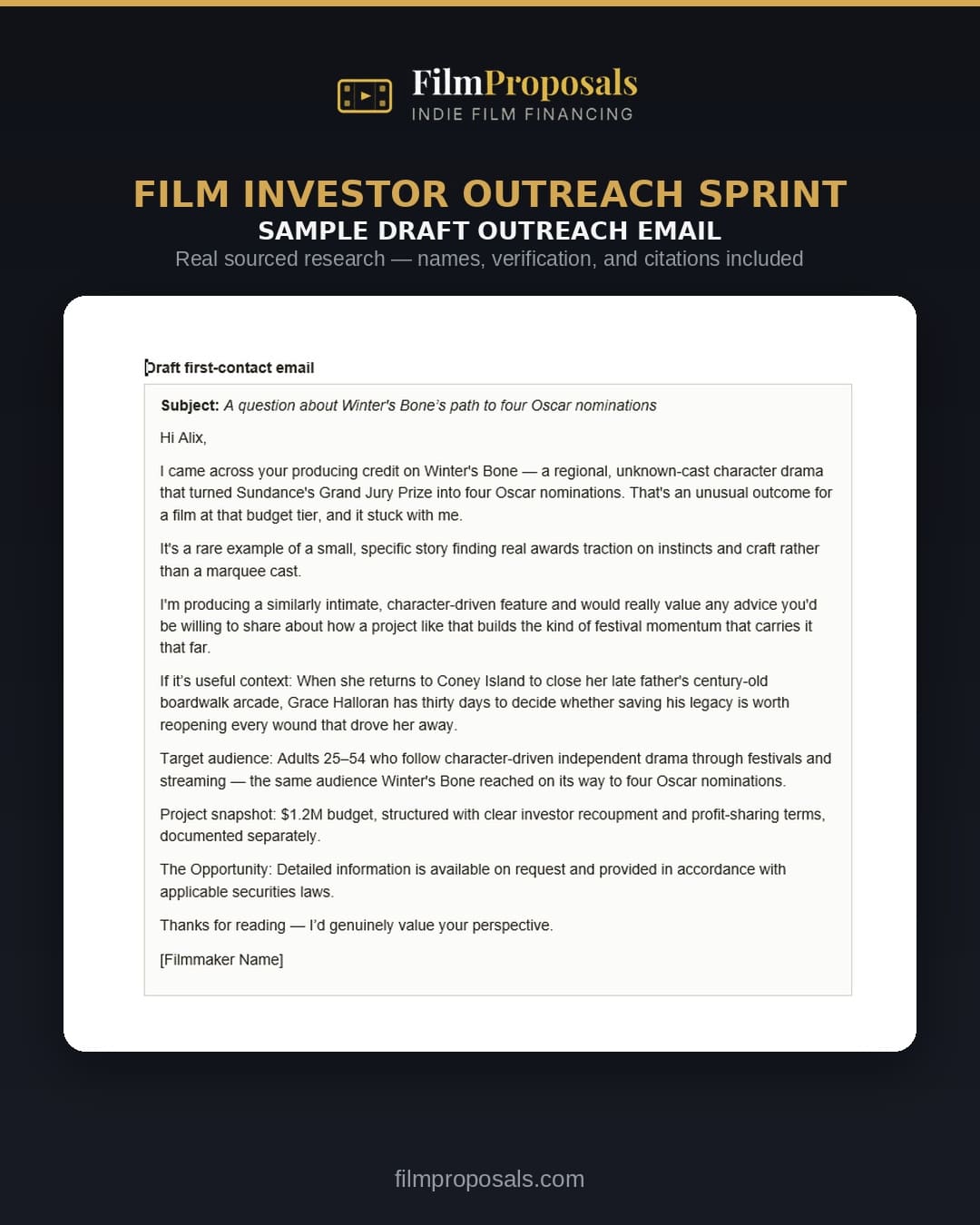
Have questions about whether your raise needs a PPM at all, or whether you’re dealing with passive investors versus active industry investors? Start in the Legal hub. If you’re ready to build the outreach strategy that gets you in front of the right investors in the first place, that’s what Investor Outreach is for.